Showing posts with label WoK. Show all posts

8 May 2014

Happy Birthday Science Citation Index!

The Science Citation Index (SCI), a key component of the Web of Science Core Collection, is 50 today!

From an idea by Dr Eugene Garfield in 1955 [1], the SCI was first published in 1964 as a five-volume print edition of indexed scientific work.  This was made available online in 1972, quickly followed by the Journal Citation Reports in 1975. 

Thomson Reuters have created a 50th anniversary web page with more information, a full timeline, and some vintage video instructions!


1. Garfield, E. (1955). Citation Indexes for Science: A New Dimension in Documentation through Association of Ideas. Science, 122 (3159),108-11.


4 February 2014

Web of Science: browser display problems

The Web of Knowledge got a new look and feel during January, including a new name, Web of Science.  However, we have had some reports that the Web of Science is not displaying or functioning properly in some instances of Internet Explorer (IE). 

If you are experiencing problems with the display of Web of Science in IE (e.g. boxes overlapping, results pushed to bottom of screen), you may find a solution here:
  • IE versions 7 or earlier are not supported browsers for Web of Science - please upgrade your browser to a more recent version.
  • Check whether you have "Compatibility View" enabled - the Web of Science will not work if this is enabled, so you will have to switch this off.  For IE 10, press the Alt key to display the Menu bar, select the Tools menu, and select Compatibility Settings.
  • Use another web browser - we have had no reported problems with Mozilla Firefox or Chrome.
If you are still experiencing problems, please send a screenshot to your Information Specialist.

10 January 2014

Changes to the Web of Knowledge


Over this weekend (Sunday 12 Jan 1400 GMT until Monday 13 Jan 0200 GMT), the Web of Knowledge will be changing its look and feel.
  • The Web of Knowledge will, in future, be known as the Web of Science
  • The group of databases that used to form the Web of Science will now be known as "Web of Science Core Collection"
  • Access to databases via the new Web of Science will remain unchanged to our subscriptions in the Web of Knowledge (i.e. Web of Science Core Collection, BIOSYS Citation Index up to 2008, MEDLINE)
  • All search functionality will remain the same, so you can continue to search the new Web of Science in the same way you previously searched the Web of Knowledge
For a brief introduction to the new Web of Science interface, watch this video.

If you have any further questions about the changes to the Web of Knowledge, please contact your Information Specialist.

1 August 2013

Web of Knowledge - enhancements


Thomson Reuters has released the latest version of Web of Knowledge which focuses on improved
ease of use with new local language interfaces, search forgiveness and improved user interface for registration and output.

Check out their recorded tutorial for full information but you will now be able to see

  • alternative suggestions for misspelt search terms
  • auto-suggestions for publication titles
  • streamlined personalisation features
  • quicker export options for example in to EndNote
  • new local language interfaces in Portuguese and Spanish

20 June 2013

2012 edition of Journal Citation Reports now available

The 2012 edition of the Journal Citation Reports from Thomson Reuters has now been published.  This will give you the most up-to-date Impact Factors for world-leading journals indexed by the Web of Science.

The Impact Factor for a journal is the average number of citations per article published in that journal.  The 2012 edition considers citations during 2012 to articles published during 2010 and 2011.

You can access the Journal Citation Reports by clicking on the Additional Resources tab within the Web of Knowledge, or directly via the A-Z Resource List.

If you would like further information about Impact Factors, the Journal Citation Reports, or bibliometrics in general, please contact your Information Specialist.

25 July 2012

Impact Factors 2011

At the end of last month, Thomson Reuters announced the release of the 2011 Impact Factors, available via the Journal Citation Reports (part of the Web of Knowledge).

The 2011 Impact Factor for a journal title is calculated as the average number of citations received in 2011 by articles published in that journal title during 2009 and 2010.

One interesting feature of the 2011 release was the exclusion of 51 journal titles due to "anomalous citation patterns" - it appears Thomson Reuters believed these journals to be engaging in practices designed to artificially inflate their Impact Factors.

For more information on Impact Factors, or guidance on finding out what the Impact Factor for a particular journal is, please contact your Information Specialist.

8 May 2012

Book Citation Indexes - 3 Month Trial

The Thomson Reuters Book Citation Index fully indexes over 30,000 editorially selected books in the sciences, social sciences and humanities (with an emphasis on the social sciences and humanities), from 2005 to the present. 10,000 new books are added each year, and all are indexed at the chapter level.  This new resource is intended to extend the discovery and analysis capabilities of the Web of Knowledge by including comprehensive book citation data.

For a brief introduction to the Book Citation Index, see the 3-min recorded training provided by Thomson Reuters or read the factsheet.

The Book Citation Index has now been enabled on a three month trial basis (from 7 May) and is accessible via the Web of Knowledge.  If you are off campus, access the Web of Knowledge via Aston e-Library.

If you have any comments about this resource, feel free to leave them below.

11 November 2011

Making library resources mobile!

Did you know that many of the resources available to you via Aston University Library & Information Services are available from your mobile device as well?

This summer, we launched a mobile version of the Library Catalogue, making it easier than ever to find books as you navigate the Library shelves. This is accessible through the usual web browser on your mobile device.

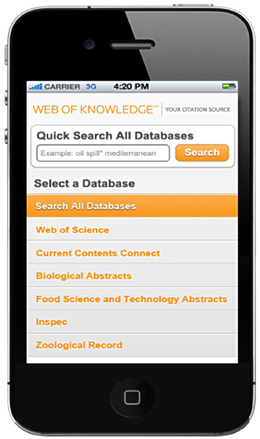
Many of our resource providers have developed mobile versions of their interfaces as well.  For example, you can access the Web of Knowledge, EBSCOhost, IEEE Xplore and JSTOR when you're out and about using the mobile interfaces provided.  Sometimes, free registration is required for access to the mobile version.  Comment on this post or ask at the Help Desk if you have any questions about this.

Some of our providers have created apps for you to download.  Elsevier provide apps for ScienceDirect and Scopus Alerts.  To download an EBSCOhost app for iPhone or Android, access EBSCOhost as normal and click the link at the bottom of any EBSCOhost page to email yourself the download instructions, access key and a link to the app store.  The RSC (Royal Society of Chemistry) have an iOS app for their journals and for ChemSpider.


19 July 2011

New interface for Web of Knowledge

On 17th July 2011 the new Web of Knowledge (WoK v5.3) became the primary platform. This means that all your links to Web of Knowledge will take you directly to the new version.

New features in version 5.3 include:
  • All terms are searched - no stop words
  • Linguistic search assistance: lemmatization (word stemming) and spelling variations
  • Left hand truncation
  • NEAR/x operator
  • All results returned
  • Abstract preview
The old version (WoK v4.10) is now the secondary platform and can still be accessed until the end of 2011. If you prefer the old version, please use the following url: webofknowledgev4.com. A link is also available from WoK 5.3 to WoK 4.10, located towards the right hand side of the screen in Wok 5.3.

Please don't hesitate to contact us if you have any questions about the new interface.